Four pieces. One supplier. No master craftsman.
The prepared duck, the oven, the process and the training: one supplier, one spec. Peking duck has reached the American market as a dish. It has not reached it as a system.
First commercial production at Plant No.1 is September 2026. We’re allocating that window now.

Everything upstream of your kitchen
We moved the specialist’s work into the plant and into the machine. What shows up at your back door is most of the way to a finished dish.
Both ends fixed — no variable in the middle
Variation enters this dish in two places: the state of the duck going into the oven, and the heat it gets once it’s in there. Traditionally one person’s judgment set both. Fix both ends to a written spec and the person in the middle stops being the variable.
Standardized equipment
A Convotherm-based unit carrying a roasting program developed jointly with Welbilt. The parameters live in the machine, not in someone’s memory.
Standardized duck
A duck prepared to a fixed spec in our own plant, on our own formula: same weight range, same treatment, same condition, every delivery.
Standardized results
The same duck at the same quality in location one and location two hundred, on a slow Tuesday lunch and a Saturday dinner rush.
This is the only way a chain puts this dish on a menu and keeps it there.
What you actually get

The duck
Not a raw bird. It’s prepared at our plant in Irwindale, California — cleaned, treated and dried on our own formula — and delivered ready to hang. What used to take a kitchen all morning is done before the truck leaves.
- A fixed weight range and a fixed preparation standard — our formula, not a commodity spec
- Lot-level traceability from our plant to your back door
- Ordered like any other line item, on a delivery schedule you can plan around

The oven
A Convotherm-based oven with the roasting program built in. The operator loads it, picks the program, runs it — there’s no judgment call to get wrong at 7 p.m. on a Saturday.
- Roughly 50 birds per unit, per day
- Installs where a commercial combi oven installs — no masonry, no live fire
- Backed by a certified service network for installation and maintenance
- New menu items arrive as parameters, sent to the ovens remotely — the kitchen loads them in one step, on our equipment

The process
A written run card covering hanging, roasting, resting and carving. It is the operating standard the rest of the system is built around, not a suggestion pinned to a wall.
- Written down, versioned, and the same in every location
- Built so a new hire can follow it on day one and get the same plate
- Updated centrally when we improve it — you’re not retraining from scratch

The training
Your people certify at our plant in Irwindale — five days for an oven operator, ten for a carver. The traditional route to a duck chef runs five to ten years and ends with one person you can’t afford to lose.
- Five days to certify an oven operator
- Ten days to certify a carver
- New hires certify on the same program as your first team, so the standard doesn’t drift with turnover
Straight answers
Is it greasy?
No. The process renders the fat out rather than leaving it in. The fat is how you get crisp skin — it isn’t what lands on the plate.
How much space does it need?
It installs where a commercial combi oven installs. No masonry hanging oven, no live fire, no purpose-built chimney — which is what puts it in mall spaces, food halls and mixed-use buildings the traditional method could never enter. Footprint, power and ventilation specs come with the fit review.
What licensing do I need?
In almost every case, nothing beyond the foodservice licensing you already hold — we confirm it against your local code during the fit review. The food-safety work of preparing the duck happens at our plant, not in your kitchen.
Do I have to change my menu?
No — one item is enough to find out. Whole duck, a plated course, a flatbread, a sandwich: you pick the form, and we build the run card around it.
Can I buy only the duck?
Yes. The duck ships on its own. It arrives cleaned, treated and dried on our formula, with the morning’s work already done. Crisp skin comes from that preparation and the roasting program working together, so tell us what ovens you run and we’ll set expectations before you order.
What happens if my chef leaves?
Nothing happens to the item. That’s the point.
How a rollout works
We don’t start with equipment. We start with whether this belongs on your menu at all — and if it does, which form of it survives your rush.
By step five, opening another location is a purchasing decision, not a hiring problem.
Fit review
We look at your format, your volumes, your kitchen and the menu item you have in mind. If it’s not a fit, we’ll say so. No charge for this stage.
Pilot
One location, one unit, one defined menu item, a fixed period. We want the answer measured in your covers and your ticket times, not in a tasting.
Certification
Your operators and carvers certify at our plant in Irwindale, on the same equipment they’ll run at home.
First delivery
Prepared duck on a delivery schedule, ovens installed and commissioned at each rollout site, service network attached. From here it behaves like any other line item on your order guide.
Replication
The same specification at your second location, and your twentieth. Nothing about the item depends on which of your people is working that night.
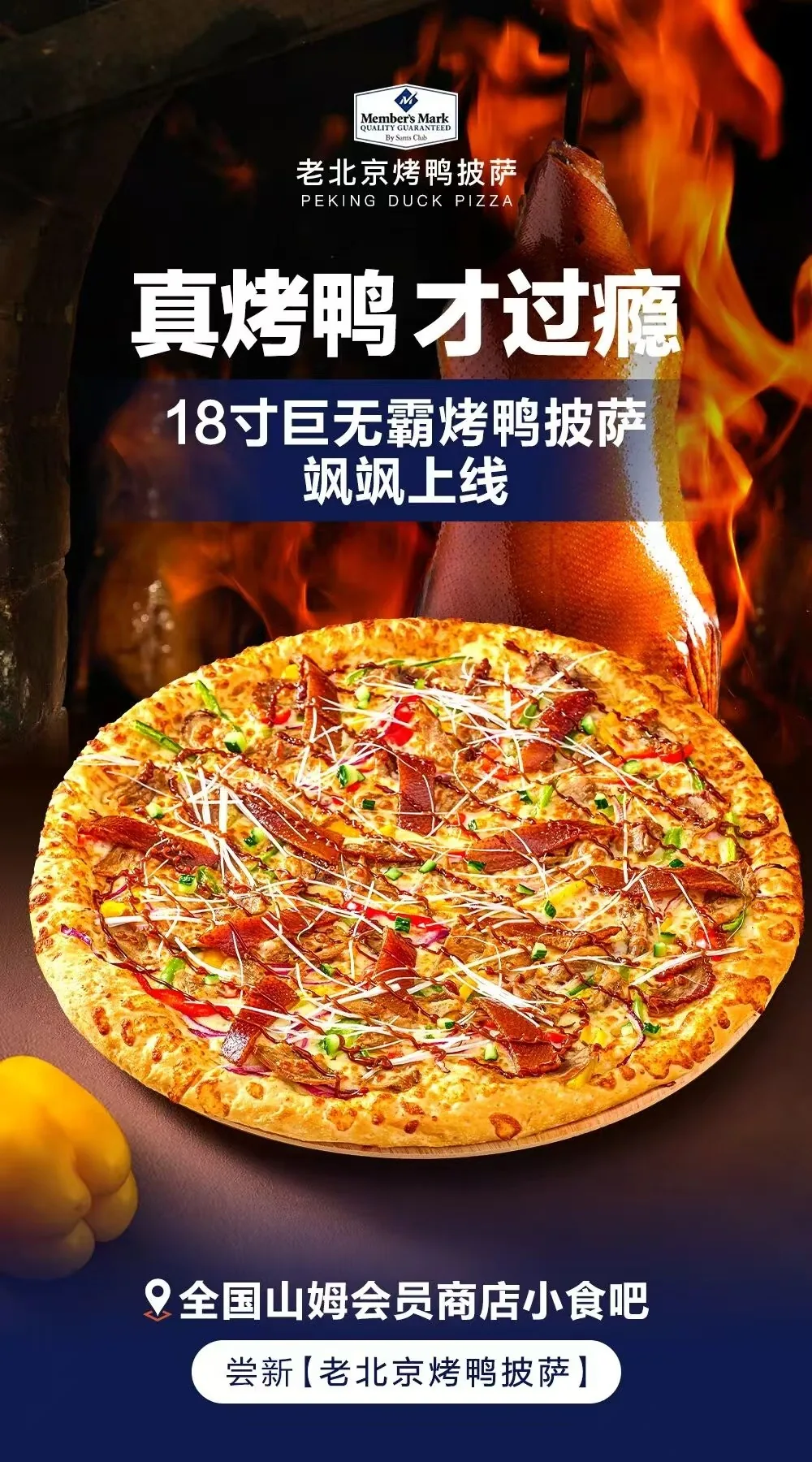
An 18-inch Peking duck pizza on a national menu in China
Sold under Member’s Mark — Sam’s Club’s own label — in the cafés of its stores across China. Standardized line, hourly crew, fixed ticket time. For a build like this, what we supply is the duck on top, and the formula can be licensed for production.


The pizza is a product in market. The other three are renderings. All four are built from the same prepared duck and the same portioned tray. In each one, what we supply is the duck. The build belongs to the operator, and the formula can be licensed for production.
Everything else on the table
The duck, the oven, the process and the training are the core. But putting this on a menu still means sourcing Mandarin pancakes, sauce, carving knives and serviceware — and then designing the menu page and the table card. We supply all of it, one spec, one order.
One purchase order for the whole kit.

On the plate
- Prepared duck, to a fixed specification
- Mandarin pancakes and wrappers
- Hoisin and the sauce set
- A written garnish and portioning standard
In the kitchen
- The roasting unit, with the program embedded
- Carving knives and boards
- Serviceware: platters, stands, carving carts
- Consumables and replacement parts through the service network
Around the launch
- Operator and carver certification at our plant
- Menu page design, in three languages
- In-store posters, table cards and window graphics
- Launch support for the first weeks of service
Tell us what you run
One restaurant, a fifty-location chain, a retail program — send us the format and the volume, and we’ll come back with a spec, a schedule and a number.